Security+ SY0-701: Study by Weighting, Not by Chapter
Comprehensive coverage of all exam domains with practical examples
Almost everyone studies for this wrong — a course start to finish, port numbers memorised, then an exam that asks for judgement on scenarios. Here is where the marks are and the one tactic that decides whether you finish in time.
Security+ is a breadth exam, and almost everyone studies for it wrong. They work through a course start to finish, memorise port numbers, and then sit an exam that asks them to apply judgement to scenarios rather than recall facts.
This covers what the exam actually tests, the one tactic that matters most on the day, and how to weight your study by the objectives rather than by whatever order a video series happens to use.
What you are sitting
The current version is SY0-701. Ninety questions, ninety minutes, and a scaled pass mark of 750 out of 900 — which is not a percentage and does not map cleanly to one, so "I need 83%" is the wrong way to think about it.
The questions come in two kinds. Most are multiple choice. A handful at the start are performance-based questions: interactive tasks where you configure a firewall rule, match attacks to descriptions, or work through a simulated console. They carry more weight than a single multiple-choice item and they take far longer.
Which leads directly to the single highest-value thing in this article.
Skip the PBQs first, then come back
The performance-based questions appear at the beginning. People start the exam, hit a fiddly simulation, and spend twenty minutes on it — leaving seventy minutes for eighty-five questions and a rising sense of panic.
Flag them and move on. Answer every multiple-choice question first, which you can do comfortably in forty to fifty minutes, then return to the PBQs with whatever remains and a known-safe score behind you.
This costs nothing, it is allowed, and it is the difference between finishing and running out of time. It is also the thing most people wish they had known afterwards.
Study by weighting, not by chapter order
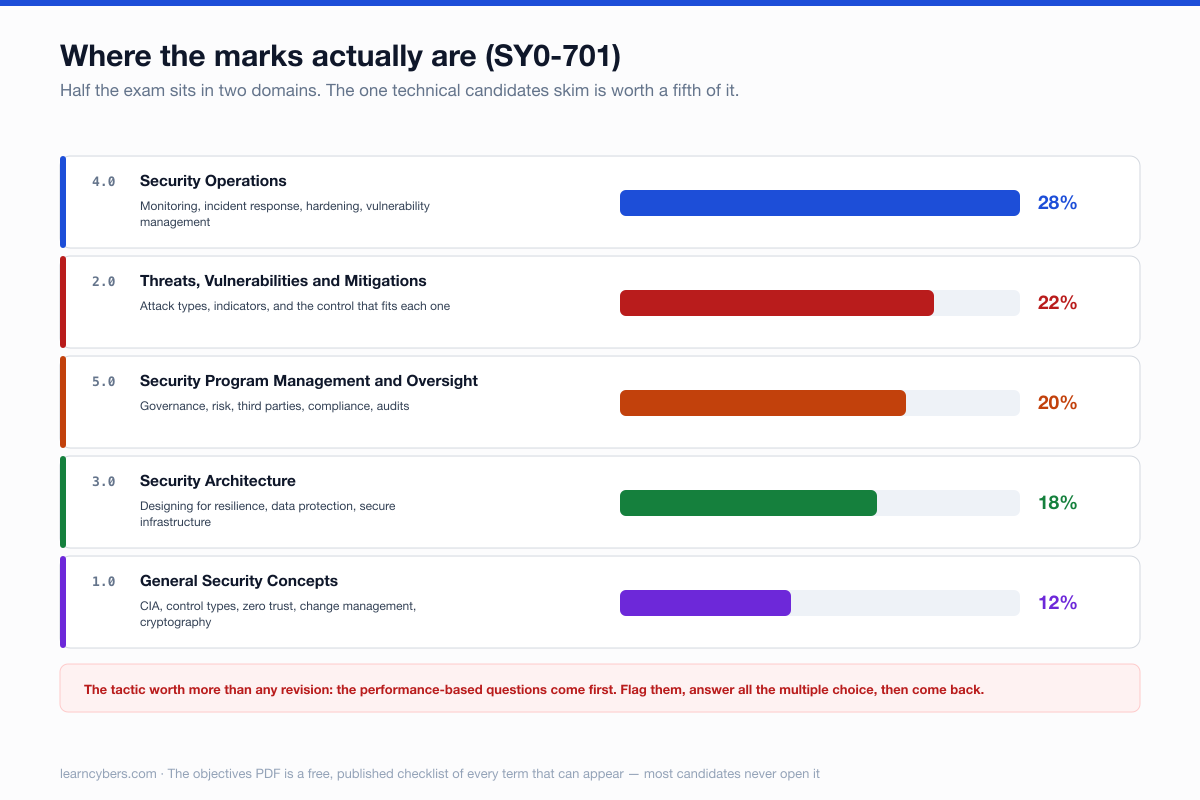
The exam objectives are published by CompTIA as a PDF, and they are the actual syllabus — a list of every term and concept that can appear. Most candidates never open it, which is strange, because it is a free checklist of exactly what is on the test.
Download it and use it as your tracker. Work down the list and mark each item as confident, shaky or unseen. When the unseen column is empty and the shaky column is short, you are ready. That is a far better readiness signal than "I finished the course".
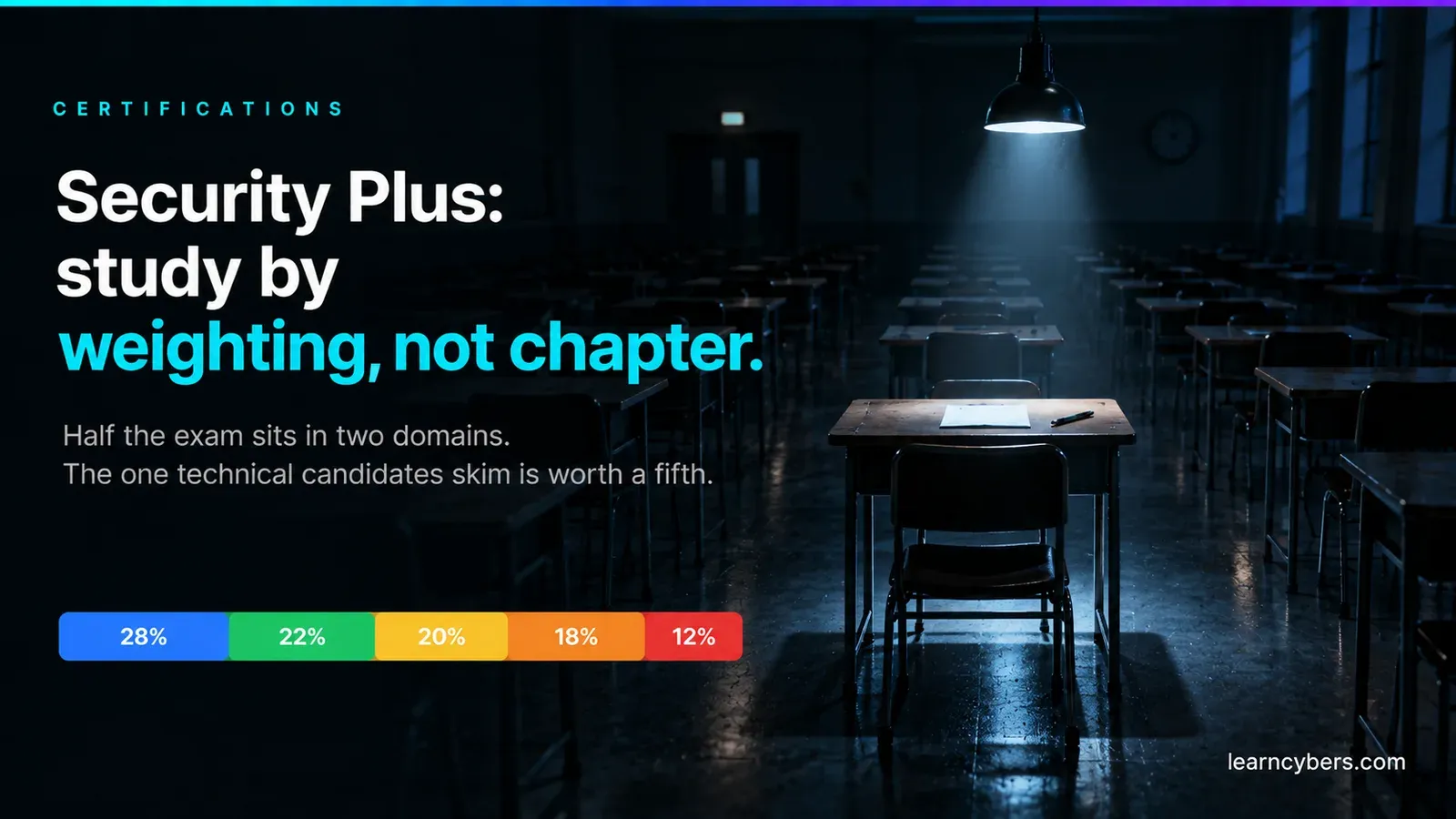
Note where the weight sits. Security Operations is the largest single domain at 28%, and Threats, Vulnerabilities and Mitigations is 22% — half the exam between them. Governance and risk carries a fifth of the marks and is the part technical candidates most often skim, because it is the least fun. Skimming a domain worth 20% is how people fail by a narrow margin.
What the questions are actually like
The common misconception is that this is a memorisation exam. It has memorisation in it, but the questions that decide your result are scenarios.
You will not be asked "what port does LDAPS use". You will be given a situation — a user reports something, a log shows something, a business has a constraint — and asked which control is most appropriate. Several answers will be technically valid. One will be the best fit for the scenario as described.
That changes how to study. For every control you learn, be able to say what problem it solves and what it costs, because the exam distinguishes options by fit rather than by correctness. Knowing that MFA exists is not the question; knowing why MFA is the answer here and network segmentation is the answer there, is.
Two habits that help. Read the last sentence of the question first, because it tells you what is being asked and the preceding paragraph is often partly irrelevant. And watch for the qualifier — most, best, first, least expensive — which is doing the real work of the question and is easy to miss under time pressure.
A realistic plan
Six to ten weeks at an hour a day is typical for someone with some IT background. Less if you work in the field already; considerably more if the vocabulary is entirely new.
- Weeks 1–4: coverage. One pass through a full course. Do not stop to perfect anything. The aim is that no term on the objectives list is completely unfamiliar.
- Weeks 5–7: the objectives list. Work it item by item, marking confidence. This is where the actual learning happens, and it is the phase people skip.
- Weeks 8+: practice exams under timed conditions. Not to memorise questions — to practise pacing and to find the weak domains. Review every wrong answer until you can say why the right one was better, not just what it was.
Professor Messer's video course and practice exams are free and widely regarded as sufficient on their own. Paid courses from Jason Dion and CompTIA's own CertMaster are the usual alternatives. You do not need all three, and buying more material is a common substitute for doing the objectives list.
On practice scores: consistently above 85% on a reputable practice set, across several attempts on questions you have not seen before, is a reasonable signal. A single good score on a set you have already worked through means nothing.
What the certification is and is not
Security+ is a breadth credential. It demonstrates that you have covered the vocabulary and concepts systematically. It does not demonstrate that you can do the work, and nobody senior believes it does.
That is not a criticism — it is what the certification is for, and it does that job well. It appears by name in job specifications and in government and defence contracting requirements, which is the practical reason to hold it. If the role in front of you names it, it is worth having, and its absence is a filter you will not get past however capable you are.
Check the current requirement for the specific role rather than any published list, including this one; approved-qualification matrices are maintained by work role and they change.
If your goal is to prove hands-on offensive capability rather than clear a filter, Security+ is not the tool and a different credential is — we compare OSCP and CEH on exactly that distinction.
Renewal, which is a subscription
The certification is valid for three years. Keeping it active means either 50 continuing education units through CompTIA's programme plus an annual fee, or passing a higher-level CompTIA certification, which renews everything below it automatically.
That second route is worth knowing early. If you intend to go on to CySA+ or a higher certification anyway, the timing matters — passing it inside your three-year window renews Security+ for free rather than paying to maintain both.
Scope
Exam code, question count, duration, pass mark and domain weightings above are for SY0-701 as published by CompTIA. Exam versions are retired on a schedule and the objectives are revised with each one, so confirm the current code and download the current objectives PDF before you start — studying for a retired version is the one mistake that wastes months rather than hours.
We have no affiliation with CompTIA or any training provider mentioned, receive nothing if you buy any of them, and have not been paid to recommend anything here.