Cybersecurity Interviews: What the Question Is Actually For
Updated for current threats, AI security, and cloud-native environments
Lists of fifty questions with model answers optimise for the wrong thing. Interviewers are working out how you think, where your knowledge stops, and whether you will say so when it does.

Lists of fifty interview questions with model answers are easy to find and close to useless, because they optimise for the wrong thing. Interviewers are not checking whether you can recite a definition of cross-site scripting. They are working out how you think, where your knowledge stops, and whether you will say so when it does.
Once you can see what a question is for, the answer becomes much easier to construct — and you stop being caught out by questions that were not on the list.
The five archetypes
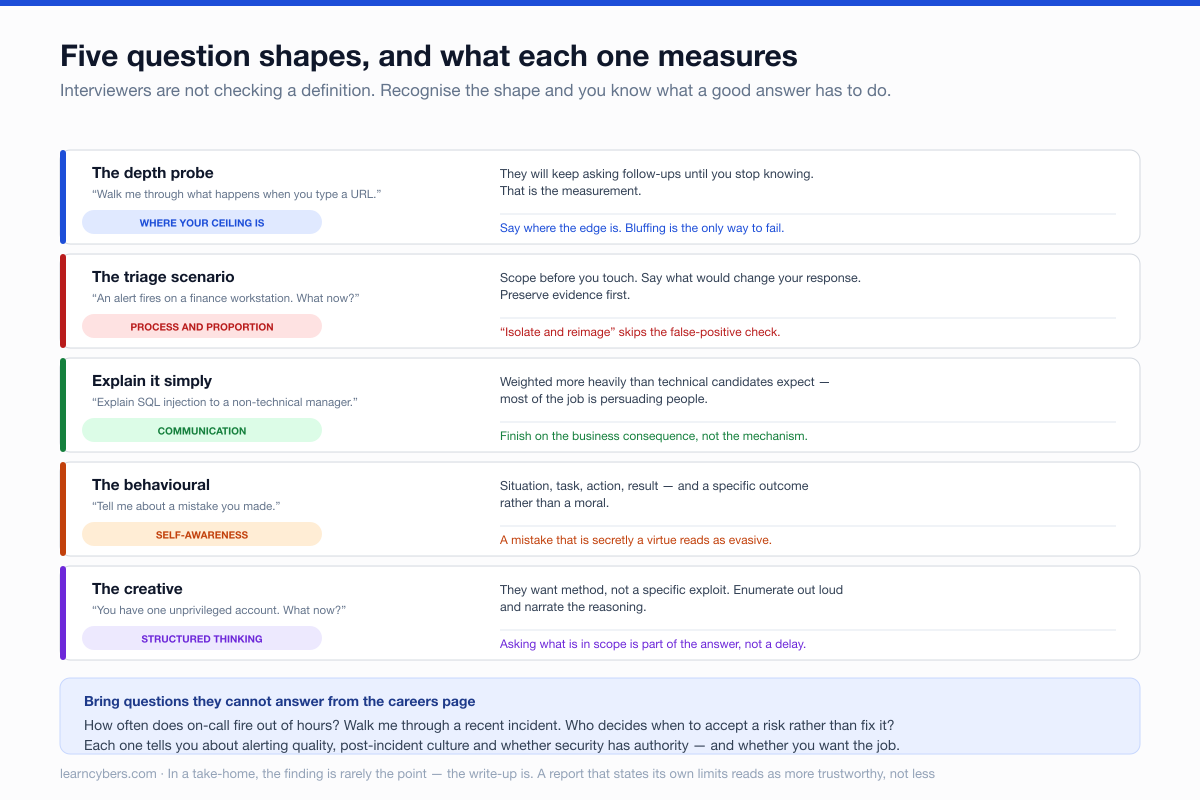
Almost every technical security interview question is one of five shapes. Recognising which one you are in tells you what a good answer looks like.
The depth probe
"Walk me through what happens when you type a URL into a browser." "How does TLS work?" "Explain DNS."
These have no right answer, and that is the point. The interviewer is going to keep asking follow-ups until you stop knowing, because what they want to measure is where your ceiling is — not whether you reach some threshold.
This means two things. Start broad and let them steer, rather than dumping everything you know at once. And when you hit the edge, say so clearly: "I know the handshake establishes a shared secret, but I could not tell you the exact message sequence in TLS 1.3 without looking it up." That is a good outcome. Bluffing is the only way to fail a depth probe, because the next question will find you out and now the interviewer has learned something worse than the gap.
The triage scenario
"An alert fires for outbound traffic to an unusual IP from a finance workstation. What do you do?"
Being assessed: process, prioritisation, and whether you contain before you investigate. There is a structure, and using it visibly is most of the score.
Scope it before you touch it — one host or many, which user, is this the only alert. Say out loud what would change your response: a domain controller is not a laptop, and an executive's machine during a merger is not a test VM. Contain proportionately. Preserve evidence before you reboot anything, because a reboot destroys memory and a lot of what you would want. Then escalate, and say who to.
Candidates lose this one by jumping straight to "I'd isolate the machine and reimage it", which throws away the investigation and does not ask whether the alert was a false positive.
The explain-it-simply question
"Explain SQL injection to a non-technical manager." "Why does this finding matter to the business?"
This is a communication test, and it is weighted more heavily than technical candidates expect, because a large part of security work is persuading people who do not report to you. Analogies help; jargon does not. Finish with the business consequence rather than the mechanism, because that is what the imagined manager actually needs.
The behavioural question
"Tell me about a time you disagreed with a decision." "Describe a mistake you made."
Use a structure — situation, task, action, result — and make the result specific. On the mistake question: pick a real one, say what you did about it, and say what you changed afterwards. Answers where the mistake is secretly a virtue ("I care too much about security") are transparent and read as evasive.
The creative question
"How would you attack this building?" "You have access to a single unprivileged account. What now?"
They are looking for structured thinking, not a specific exploit. Enumerate methodically, narrate your reasoning, and ask clarifying questions — what is in scope, what is the goal, what am I assumed to already have. Asking those questions is part of the answer, and candidates who dive straight in miss marks for it.
Four questions that come up, and what a good answer does
"What is the difference between encoding, encryption and hashing?" The trap is defining three things and stopping. The good answer names the purpose of each: encoding is for compatibility and is reversible by anyone, encryption is for confidentiality and is reversible with a key, hashing is one-way and is for verification. Then add why it matters — base64 is not a security control, and people who conflate them ship credentials in "encrypted" URLs.
"How would you secure a new web application?" An unbounded question testing whether you prioritise. Do not list twenty controls. Ask what it does and who uses it, then give an ordered answer with reasons: authentication and authorisation at the data layer first, then input handling and output encoding, then transport and headers, then logging so you can tell what happened. Ordering with justification is the whole answer.
"What is your home lab / what have you broken recently?" Genuinely trying to find out whether you are interested in this outside of work. Specifics win: a CTF you got stuck on and how you got unstuck, a tool you wrote, a CVE you read the write-up for and understood. "I follow security news" is not an answer.
"Where do you see the field going?" A judgement test. Have one opinion, held with reasons, and be willing to say what would change your mind. Reciting vendor talking points about AI is the worst available answer; saying that agentic tooling has moved the interesting problem from the model to the permissions you granted it is a real position.
Questions to ask them
Bring three or four, and make them the kind you cannot find on the careers page. These also tell you whether you want the job.
- "What does the on-call rotation look like, and how often does it fire out of hours?" The answer tells you about their alerting quality and their staffing at once.
- "Walk me through a recent incident — what went well and what did not?" A team that can answer this openly has a functioning post-incident culture. A team that cannot has something else.
- "Who decides when to accept a risk rather than fix it?" This tells you whether security has authority or only opinions.
- "What is the biggest piece of security debt you are carrying?" Everyone has one. Whether they will name it tells you how candid this team is.
The practical exercise, and what is being graded
If there is a take-home or a live exercise, the finding is rarely the point. What is being read is the write-up.
Can you describe impact in terms someone non-technical can act on? Are your reproduction steps actually reproducible? Did you distinguish what you confirmed from what you suspect? Did you say what you did not check and why — time, scope, access? A report that states its own limits reads as more trustworthy, not less, and that instinct is exactly what the job requires.
And do not exceed the stated time box. If they say four hours, spend four, and write down what you would have done next. Handing in twelve hours of work signals poor judgement about scope, which is a real part of the role.
Scope
The archetypes and advice here are drawn from how these interviews are commonly structured rather than from a survey, and practice varies widely by organisation — a consultancy, a product team and a government contractor will weight these very differently.
Nothing here is a script. An answer that sounds rehearsed performs worse than a rougher one that is clearly your own thinking, which is the main reason the fifty-questions-with-answers format does candidates so little good.